Showing posts with label Costa Rica. Show all posts
Friday, December 10, 2010
Last day in Tortuguero
Well, the monkeys were right and I was wrong, of course.
Mantled Howler Monkeys are excellent short-term weather forecasters, no doubt because their place high up in the canopy provides them with fabulous views of the sky. So when I opened the nets today around noon, when the rain seemed to let up a little bit, it was accompanied by hoots of derision from across the river.
Indeed an hour or so later it was raining again, and it never stopped. Bird banding can take place in light rain, so I ran the nets for two hours, in hopes of a surprise maybe on my last day of banding in Tortuguero, Costa Rica. But all I caught was a Gray Catbird, a female White-collared Manakin (recapture), and one of the pair of Northern Barred Woodcreepers that have a territory around the net lanes. The poor woodcreeper I released without processing this time, for it has already participated generously in this study.
The above photo is from a few days ago, and shows a wing of a first-year female Scarlet Tanager. I'm afraid this is the kind of bird photo only hardcore banding nerds will appreciate, for it shows a molt limit in the greater coverts, by which we can age this bird as a HY (hatch year) individual. Yeah, I know...
Labels:
Costa Rica,
Tortuguero
Wednesday, December 8, 2010
Late Scarlet Tanager migration?
| Scarlet Tanager |
And... one other species that's neither a year-round resident nor a winter visitor here: Scarlet Tanager.
Apparently, this species is still migrating!
In fact, four out of five of my Scarlet Tanager captures here - and I've been banding from October 21 until today - have been in December. All five individuals were hatch year birds. There was a bird (male or female) on 12 November, followed by a male on December 3, then a female on December 6, and both a male and a female on December 7.
The BNA account for this species says that "most birds do not depart breeding grounds until mid- to late Sep; at Cape May, NJ, peak fall migration 10-20 Sep; Georgia late Sep - early Oct. Departure from Gulf coastal states by mid-Oct. Arrival dates at wintering grounds poorly documented, but the few available records suggest birds reach Colombia by mid-Oct, Ecuador by 1 Nov, and Bolivia by mid-Oct to mid-Nov" (Mowbray 1999).
Scarlet Tanager is a trans-Gulf migrant, and part of the route in fall is through Central America (including Costa Rica). See Fig 1 below.
Figure 1: Scarlet Tanager breeding range, migration routes and winter range.
By Lincoln, Frederick C., Steven R. Peterson, and John L. Zimmerman. [Public domain], via Wikimedia Commons. Image courtesy of the U.S. Geological Survey.
Wondering if this little early December wave, apparently consisting entirely of first-year individuals, is something unusual or in fact annual, I consulted eBird. Here's an animated gif of all Scarlet Tanager 'fall' records in their database, ordered by month, starting with July, and running until December. See Fig 2 below:
Figure 2: Scarlet Tanager records in eBird by month, from July until December.
Image provided by eBird (www.ebird.org) and created 8 December 2010.
Observer effort of course varies widely along the Scarlet Tanager's range, which explains why the wintering grounds don't all light up green as the breeding grounds are vacated. Still, we can see Costa Rican records light up in October and November, and then none for December!
How curious then that I caught zero Scarlet Tanagers during the second half of October, only one in November, and then four in the first week of December!
References:
eBird. 2010. eBird: An online database of bird distribution and abundance [web application]. Version 2. eBird, Ithaca, New York. Available: http://www.ebird.org. (Accessed: December 8, 2010).
Mowbray, Thomas B. 1999. Scarlet Tanager (Piranga olivacea), The Birds of North America Online (A. Poole, Ed.). Ithaca: Cornell Lab of Ornithology; Retrieved from the Birds of North America Online: http://bna.birds.cornell.edu/bna/species/479
Labels:
Costa Rica,
Scarlet Tanager,
Tortuguero
Monday, December 6, 2010
A family affair?
| Sandwich Tern with Royal Terns |
Yesterday afternoon, I walked out to the mouth of the Tortuguero River, where a number of them can usually be found.
About a third of the individuals in this group were banded. A little bit of online research showed me there's a considerable banding effort on the United States Eastern Seaboard each year, involving thousands of Royal Terns being banded in Maryland, Virginia and North Carolina. Go here for an account of a Honduran intern's experience banding Royal Terns with the Maryland Coastal Bays Program.
Four of the five banded individuals I saw can be seen in this photo. Even within the group, they seemed to associate more closely with each other, something I'd noticed with banded individuals in New Jersey and El Salvador also. According to the BNA account, Royal Terns are "highly social and gregarious throughout the year, assembling into compact flocks up to several thousand, often in family groups, but occasionally solitary outside the breeding season (Buckley & Buckley 2002, emphasis added).
References:
Buckley, P. A. and Francine G. Buckley. 2002. Royal Tern (Sterna maxima), The Birds of North America Online (A. Poole, Ed.). Ithaca: Cornell Lab of Ornithology; Retrieved from the Birds of North America Online: http://bna.birds.cornell.edu/bna/species/700
Labels:
Costa Rica,
Royal Tern,
Sandwich Tern,
Tortuguero
Saturday, December 4, 2010
Mangrove Cuckoo
| Mangrove Cuckoo |
The more recent Garrigues & Dean (2007) summarizes this information, noting the bird is a "fairly uncommon Central American migrant from December to June in northwestern Pacific lowlands; uncommon to rare in southern Pacific lowlands and in western Central Valley."
Not a bird then one would expect on the Caribbean coast.
However, the checklist for Tortuguero, found in Ralph et al. (2008), does list Mangrove Cuckoo as a rare resident.
| Mangrove Cuckoo |
Note the all dark upper mandible, the absence of rufous in the wing, the more pronounced dark mask, and the buffy wash on the underparts - all features that distinguish this species from Yellow-billed Cuckoo. There's a difference in the tail pattern also, but these photos don't capture that aspect very well.
Cited literature:
Garrigues, R. and R. Dean. 2007. The Birds of Costa Rica: a Field Guide. Cornell Univ. Press, Ithaca, NY.
Ralph, C.J., M. Widdowson, B. Widdowson, B. O'Donnell & R.I. Frey. 2008. Tortuguero Bird Monitoring Station Protocol, unpublished draft version January 2008.
Stiles, F. G. and A. F. Skutch. 1989. A guide to the birds of Costa Rica. Cornell Univ. Press, Ithaca, NY.
Labels:
Bird identification,
Costa Rica,
Mangrove Cuckoo,
Tortuguero
Wednesday, December 1, 2010
Stormy weather
A couple of days ago, it started raining here in Tortuguero, on the Caribbean coast of Costa Rica, and it hasn't stopped since. The rain has been heavy at times, which even caused a power outage for most of the morning today.
As the rain was letting up a bit towards midday, I thought I'd venture out on the beach to see what's doing.
Immediately I realized that the birding there was as fabulous as it was difficult. Strong winds, darkness from heavy overcast skies combined with the rain made for very poor visibility. But there was a good number of birds out there, especially Laughing Gull was abundant. There was a constant stream of laughers heading southeast parallel to the beach, and I think I saw nearly a thousand individuals in about an hour's time.
Other birds seen were two jaeger spp., a Common Tern, a couple of sulids, and this bird, a Black Noddy. Unlike the others, this is a true pelagic and not normally seen from the beach here.
The sulids were likely Brown Boobies, a species that I see regularly off the beach here, even in calm weather. Although I wouldn't rule out Red-footed Booby. Last Sunday, someone brought in a sickly booby, which died later that day. Despite its yellow legs and feet, certain measurements (specifically tarsus and tail) and plumage characters (uniform dark plumage, light tip to dark tail) pointed in the direction of the locally much rarer, because much more pelagic, Red-footed Booby.
This bird, however, I believe is a juvenile Brown Booby.
As the rain was letting up a bit towards midday, I thought I'd venture out on the beach to see what's doing.
Immediately I realized that the birding there was as fabulous as it was difficult. Strong winds, darkness from heavy overcast skies combined with the rain made for very poor visibility. But there was a good number of birds out there, especially Laughing Gull was abundant. There was a constant stream of laughers heading southeast parallel to the beach, and I think I saw nearly a thousand individuals in about an hour's time.
| Black Noddy |
The sulids were likely Brown Boobies, a species that I see regularly off the beach here, even in calm weather. Although I wouldn't rule out Red-footed Booby. Last Sunday, someone brought in a sickly booby, which died later that day. Despite its yellow legs and feet, certain measurements (specifically tarsus and tail) and plumage characters (uniform dark plumage, light tip to dark tail) pointed in the direction of the locally much rarer, because much more pelagic, Red-footed Booby.
| Brown Booby |
Labels:
Black Noddy,
Brown Booby,
Costa Rica,
Tortuguero
Sunday, November 28, 2010
Laughing Falcon
| Laughing Falcon |
Here it is, looking down for its favorite food, snakes.
The buffy tips of the back feathers indicate that this is an immature bird.
I think I also see a molt limit in the greater coverts, with two lighter and longer inner feathers contrasting with fresher outer greater coverts.
Labels:
Costa Rica,
Laughing Falcon,
Tortuguero
Saturday, November 27, 2010
Sooty Tern
Today, one the gardeners here at the Tortuguero Sea Turtle Conservancy handed me this bird, an adult Sooty Tern. He had found it in the water, unable to fly and just barely able to float, in the Tortuguero River near the river mouth.
I took the bird under my care and first made sure to dry it, as it was completely soaked. I checked for injuries but couldn't find any. The bird just seemed really exhausted, so I put it on a long-sleeve shirt in a carton box, and let it rest for a while. Three hours later, however, it was dead.
As I weighed it, and found that it only weighed 127 g, nearly half the weight of a healthy adult, I realized that it probably never had much of chance to begin with, poor thing.
Although globally one of the most abundant seabirds, in Costa Rica Sooty Tern is "a very rare visitor to Pacific coastal waters; no record yet for Caribbean coast" (Stiles & Skutch 1989). This is now outdated information (for example, there was a Tortuguero record last year, Pablo Elizondo pers. comm.) but the species certainly remains rare on the Caribbean coast. Heavy rains started last night and lasted until mid-morning; possibly this individual got disoriented in a nasty weather system.
Cited literature:
Stiles, F. G. and A. F. Skutch. 1989. A guide to the birds of Costa Rica. Cornell Univ. Press, Ithaca, NY.
I took the bird under my care and first made sure to dry it, as it was completely soaked. I checked for injuries but couldn't find any. The bird just seemed really exhausted, so I put it on a long-sleeve shirt in a carton box, and let it rest for a while. Three hours later, however, it was dead.
As I weighed it, and found that it only weighed 127 g, nearly half the weight of a healthy adult, I realized that it probably never had much of chance to begin with, poor thing.
Although globally one of the most abundant seabirds, in Costa Rica Sooty Tern is "a very rare visitor to Pacific coastal waters; no record yet for Caribbean coast" (Stiles & Skutch 1989). This is now outdated information (for example, there was a Tortuguero record last year, Pablo Elizondo pers. comm.) but the species certainly remains rare on the Caribbean coast. Heavy rains started last night and lasted until mid-morning; possibly this individual got disoriented in a nasty weather system.
Cited literature:
Stiles, F. G. and A. F. Skutch. 1989. A guide to the birds of Costa Rica. Cornell Univ. Press, Ithaca, NY.
Labels:
Costa Rica,
Sooty Tern,
Tortuguero
Wednesday, November 24, 2010
Northern Barred Woodcreeper
| Northern Barred Woodcreeper |
Their distinctively shaped tails provide strong support as they forage for small invertebrate prey on tree trunks. Note the width of the feather shafts on that tail!
| Northern Barred Woodcreeper |
| Northern Barred Woodcreeper |
Labels:
Costa Rica,
Northern Barred Woodcreeper,
Tortuguero
Saturday, November 20, 2010
Green Turtle hatchlings
A few more shots and a little video of Tortuguero's most famous residents, the Green Turtles, Chelonia mydas. The breeding season is largely over for them, although I still find tracks of females on the beach every now and then. The female emerges from the sea and climbs on to the beach at night, shuffles for 25 m to a place beyond the high tide line, digs a hole and deposits her eggs in it. She then covers up the hole with sand, and returns to the sea.
Sixty days or so later, these guys emerge.
They are usually full of energy and go straight for the sea.
As small as they are, they are vulnerable to predators while making the 25 m journey to sea.
Almost there!
I've seen Green Turtle hatchlings on the beach a number of times now, but, as one of the turtle researchers here said the other day, it never gets old.
Here's a short video of a Green Turtle hatchling making the trek across the beach to the sea:
Labels:
Costa Rica,
Green Turtle,
Tortuguero
Thursday, November 18, 2010
Caño Palma
| White-whiskered Puffbird |
Here are some fairly gratuitous photos of birds encountered there. I loved the banding at this site, where the emphasis is more on resident birds, less on migrants. That said, the most exciting capture probably was of a migrant: a recaptured Northern Waterthrush. This bird was first captured in Tortuguero in March of 2006, when its fat score was 'zero', and then again a month later, when it had fattened up for migration to a 'six'. And now we caught it again. Assistant bander Eveling Tavera caught and processed it, I actually never saw the bird. Thus, I have no photos of it.
But I've got shots of some pretty neat residents. The bird at the top is a male White-whiskered Puffbird, a bird found from southeastern Mexico to Ecuador.
| Red-capped Manakin |
| White-collared Manakin |
The male White-collared Manakin is also good-looking. The green females are common around the CCC site, in fact it's one of the most commonly caught species. But I have yet to catch an adult male. The adult males tend to hang out near their leks, where they perform a dance that involves a wing snapping movement, which produces a sound not unlike that of popping popcorn. These males also are easily seen and heard at the Caño Palma site.
| Golden-hooded Tanager |
Golden-hooded Tanager. This species is common in the station's yard at Caño Palma.
| Collared Aracari |
Collared Aracari.
With the banding site well-prepared now, I think I will be back there once or twice before I go. It's a hundred times buggier (mosquitos) than the CCC site, and a bit more rustic, but it also has lots of interesting birds.
Monday, November 15, 2010
Strawberry Poison-dart Frog
Today a few photos of the Strawberry Poison-dart Frog (Dendrobates pumilio), an amazingly beautiful and really quite common little frog from the Caño Palma site in Tortuguero, where I am banding for a few days. This site is a only 20-minute boat ride from the "CCC" site where I had been banding since October 21, but it's very different habitat, with different critters.
Like most poison-dart frogs, its toxicity is derived from its diet (mostly formicine ants). Kept in captivity and fed on arthropods, these frogs lose their toxicity.
They are small and beautiful.
There's also a fascinatingly different bird community here, on which I will report a next time.
Like most poison-dart frogs, its toxicity is derived from its diet (mostly formicine ants). Kept in captivity and fed on arthropods, these frogs lose their toxicity.
They are small and beautiful.
There's also a fascinatingly different bird community here, on which I will report a next time.
Labels:
Costa Rica,
Strawberry Poison-dart Frog,
Tortuguero
Sunday, November 14, 2010
Wasp-mimicking Tiger Moth
Today a photo of a Wasp-mimicking Tiger Moth, Isanthrene crabroniformis, from Tortuguero, Costa Rica. Except for the antennae, it doesn't really look like a moth.
Neither does this one. But this is also a moth, Urania Swallowtail Moth (Urania fulgens) playing hide and seek with another one on the other side of the leaf. These diurnal moths are very common in Tortuguero.
Thursday, November 11, 2010
A very late Sulphur-bellied Flycatcher
Today the banding session here in Tortuguero, Costa Rica began with rain, which was light when I opened the nets but quickly turned to a downpour that lasted for a couple of hours, which had me close them. For a while, it didn't look like I was going to be able to reopen, but around 10 AM, the rain had stopped, so I opened again.
I did not catch very much, but there was a surprise in the form of this very late Sulphur-bellied Flycatcher. Late because this bird, which breeds from southeast Arizona and Mexico down to Costa Rica but winters in South America, is a common passage migrant in Costa Rica from early August to mid-October (Garrigues & Dean 2007, Stiles & Skutch 1989).
Precisely because it is so late, it occurred to me that other Myiodynastes flycatchers, perhaps even South American species, had to be carefully ruled out. Streaked Flycatcher is of course very similar to Sulphur-bellied, and does occur in Costa Rica, even winters here (mostly on the Pacific slope, rare on the Caribbean slope). Obviously we need to start with that bird.
The BNA account for Sulphur-bellied is not very encouraging in this respect, for it claims that Streaked Flycatcher is "often not readily distinguishable in the field". It goes on, however, to list distinguishing field marks: "Streaked is larger with a more robust bill [...], that has extensive pale area at base of lower mandible (dark only on distal half), a narrower dusky malar streak that rarely meets across the chin, which typically is whitish on Streaked and blackish on Sulphur-bellied. [Streaked also with] yellowish-tinged supercilium and mustachial stripes (unlike Sulphur-bellied). [...] Sulphur-bellied also has coarser streaking on underparts; (often) brighter yellow on belly; grayer, less tawny crown; and more whitish edgings on wing coverts (lacks rufous or buff edgings)" (Lowther & Stotz 1999).
With the very notable exception of the coloration of the lower mandible, everything here fits our bird. While holding the bird in the hand, I noticed the light but extensive yellow on the belly, the dark malar stripe, and the whitish (not creamy) supercilium. For me, it was a Sulphur-bellied Flycatcher. At this point, I was still unaware of a reputed difference in the lower mandible.
But practically every field guide mentions it!
Howell & Webb (1995): "Sulphur-bellied Flycatcher has smaller bill [than Streaked Flycatcher] with little or no flesh below at base."
Stiles & Skutch (1989): "Sulphur-bellied Flycatcher has darker bill, chin and malar area than Streaked Flycatcher, with belly at least as yellow as breast."
Garrigues & Dean (2007): "Streaked Flycatcher very similar in appearance to Sulphur-bellied Flycatcher, but differs in having pink basal half of lower mandible, cream-colored superciliary, thin malar stripe, and whitish belly." (their emphasis)
Pyle (1997) mentions a measurable difference in bill size, which, had I known about it, I would have checked for on this bird. But I only found out after I let it go. He also mentions differences in the width of the streaks in the outer tail feathers, which are <3 mm wide in Sulphur-bellied and >3 mm wide in Streaked Flycatcher. He concludes with differences in malar stripe and chin color, and again with a color difference on the lower mandible: "lower mandible [of Sulphur-bellied Flycatcher] with an indistinct or no pale base (vs base of lower mandible extensively pale pinkish in Streaked Flycatcher)."
There are three more Myiodynastes flycatchers found in South America, but none of them look like this bird. Only Variegated Flycatcher shares some plumage characters, but that bird has a smaller head and a much smaller bill.
Sticking with Sulphur-bellied Flycatcher vs. Streaked Flycatcher, I believe this to be a Sulphur-bellied Flycatcher. All field marks are good for that species, except the coloration of the lower mandible.
As I was preparing this post, I consulted via Skype with Oliver Komar and Carlos Funes of SalvaNATURA. They looked at my photos and compared them with eight photos of Sulphur-bellied Flycatcher in the SalvaNATURA visual database. Six birds showed some pink at the base of the lower mandible, and two almost none. Clearly, this is a variable character, with my bird today likely at the other end of the spectrum.
12 November 2010 postscript:
Here are some photos from Arizona of Sulphur-bellied Flycatchers, including one photo of an individual with about as much light color on the lower mandible as my bird.
Two photos of Streaked Flycatcher from Peru with a darker lower mandible can be seen here.
Clearly, this character is variable and should not be used to separate the two species.
Acknowledgments:
Thanks to Oliver Komar and Carlos Funes for commenting on this bird, and for comparing photos of other Sulphur-bellied Flycatcher individuals.
Cited literature:
Garrigues, R. and R. Dean. 2007. The Birds of Costa Rica: a Field Guide. Cornell Univ. Press, Ithaca, NY.
Howell, Steve N.G. and Sophie Webb. 1995. A Guide to the Birds of Mexico and Northern Central America, Oxford University Press, Oxford, England.
Lowther, Peter E. and Douglas F. Stotz. 1999. Sulphur-bellied Flycatcher (Myiodynastes luteiventris), The Birds of North America Online (A. Poole, Ed.). Ithaca: Cornell Lab of Ornithology; Retrieved from the Birds of North America Online: http://bna.birds.cornell.edu/bna/species/475
Pyle, Peter. 1997. Identification Guide to North American Birds, Part 1 Columbidae to Ploceidae. Slate Creek Press, Bolinas, California.
Stiles, F. G. and A. F. Skutch. 1989. A guide to the birds of Costa Rica. Cornell Univ. Press, Ithaca, NY.
Tuesday, November 9, 2010
Chestnut-sided Warbler
Today, I had two Chestnut-sided Warblers side by side in the net. That in itself is not so remarkable, given how common they are here in Tortuguero, Costa Rica, as migrants and winter visitors. I see these birds practically every day, usually a little higher in the canopy. I don't catch them very often.
In fact, since I've been here, I've only caught two individuals before these two. One was on the 21st of October, my first day of banding here. The other was on the 29th of October. That second bird got out of the net on its own, before I could extract it.
What is remarkable about today's capture, however, is that one of the birds was already banded - and it wasn't the October 21 bird! Unfortunately, I don't have access to the banding database of this site, so I cannot yet be 100% sure of this, but I think this may be a recapture from somewhere else!
As you can see when you click on the photo, the band ends in a 6. The full band code was 211094346. I looked at the (paper) banding records going back to 16 October 2010, when Evan Adams started banding here, and I do not find any record of this band. In fact - and here's the kicker - I do not find any 0 or similar sized band records that start with 211!
This last bit of evidence tells me that the series from which this band came is not from here. I aged the bird as a HY (hatch year) bird, based on a molt limit visible in the primary coverts. So, unless I am very much mistaken, this bird was very likely banded somewhere else earlier this year!
If so, it would be a great capture, for this is really why we band birds in the first place. But again, just like the recent putative Bicknell's Thrush captures, we won't know for sure until later. I'll have to check with the site coordinator whether this is really a recapture from someplace else. If so, it will likely take a bit more time before we know where it was banded.
Postscript 24 November 2010:
This bird was banded right here in Tortuguero in October 2008! Not a hatch year bird then; I still need a lot more experience ageing warblers, which is more difficult than, say, thrushes. But the recapture, two years later, seems to imply either winter site fidelity or, at the very least, a preference for using the same migration route among years. A third capture outside migration season would clinch it. But what are the odds of that?
Labels:
Chestnut-sided Warbler,
Costa Rica,
Tortuguero
Monday, November 8, 2010
Oops!... I did it again
I think I caught another Bicknell's Thrush today!
This morning it was obvious that migration was good overnight, for I caught many birds with only a few nets open. The vast majority were Catharus thrushes, with 23 Swainson's Thrushes, 2 Gray-cheeked Thrushes, 1 Veery, and the above individual. For me, this is another candidate for Bicknell's Thrush.
This bird has no obvious eye ring or supraloral mark, so we can quickly rule out Swainson's Thrush. It's not a Veery either, for it lacks the reddish tone on the upperparts, and has more spotting on the breast than Veery does. It could be a Gray-cheeked, except the colors are a little warmer than on the average Gray-cheeked. Also, it has a buffy wash on the throat, unlike Gray-cheeked. And the wing formula seems better for Bicknell's than for Gray-cheeked. (See also previous post for a discussion of this and other characters.)
Then if I tell you that the wing cord was 93 mm (almost too short for Gray-cheeked, about average for Bicknell's) and that the tail measured 61 mm (definitely too short for Gray-cheeked but about average for Bicknell's Thrush), I think you see where I'm going with this!
Another thing I noticed on this bird, having read up on Catharus thrushes since last week's intriguing capture, was the color of the legs. Pyle mentions for Bicknell's Thrush "legs flesh with a purplish tinge or a brownish-dusky wash, darker than toes" while his description of the Gray-cheeked Thrush's legs is "pale flesh with a dusky wash, paler than the toes" (Pyle 1997). In the hand, I did see a purplish tinge, and while I didn't take any photos of the legs specifically, I think we can appreciate in the third photo that the toes of this bird are lighter than the legs.
Obviously, this time I did collect a tail feather, and you can see quite well which one it is, from the third photo.
It will very likely be months at the very least before the feather has been analyzed, and we have a bit more certainty which species this is.
Assuming for a minute that both birds really were Bicknell's Thrushes, could it be that this species has been under-reported in Central America? Another, perhaps more likely possibility is that a small percentage of Catharus thrushes cannot safely be identified to species, even in the hand.
Another surprise find today was this bird, White-throated Thrush. Normally a middle elevations species (like the White-crowned Manakin of last week), not a bird expected at sea level. Like the manakin, this bird is not listed on the checklist included in the banding protocol for the site (Ralph et al. 2008), although both Stiles & Skutch (1989) and Garrigues & Dean (2007) mention post-breeding altitudinal migration in this species.
Cited literature:
Garrigues, R. and R. Dean. 2007. The Birds of Costa Rica: a Field Guide. Cornell Univ. Press, Ithaca, NY.
Pyle, Peter 1997. Identification Guide to North American Birds, Part 1 Columbidae to Ploceidae. Slate Creek Press, Bolinas, California.
Ralph, C.J., M. Widdowson, B. Widdowson, B. O'Donnell & R.I. Frey. 2008. Tortuguero Bird Monitoring Station Protocol, unpublished draft version January 2008.
Stiles, F. G. and A. F. Skutch. 1989. A guide to the birds of Costa Rica. Cornell Univ. Press, Ithaca, NY.
Friday, November 5, 2010
Bicknell's Thrush!
Two days ago, I caught what I think will easily be the hottest capture of the season: a Bicknell's Thrush! If accepted, this would represent not only a first record for Costa Rica, but for all of Central America!
Casually looking at it as I pulled it out of the net, I thought it was a Gray-cheeked Thrush - after Swainson's Thrush the second most common spotted Catharus thrush here in Tortuguero, Costa Rica. While processing the bird, however, I quickly noticed it was different from that species in several ways.
For starters, the wing cord was exceedingly short: 93 mm. Most Gray-cheeked Thrushes have a wing cord of >97 mm, many >100 mm. In fact, the whole bird was small, with a tail coming in at 65 mm (63-97 mm for Gray-cheeked; 59-74 mm for Bicknell's, according to Pyle). The body mass was 27.0 g. Then I noticed how warm the colors were compared to the average Gray-cheeked. I further noticed a contrast between the tail and the back. The bird also showed a buffy wash on the throat, unusual for Gray-cheeked.
Realizing I was holding a Catharus thrush that didn't easily fit into one of the three species found here (Swainson's, Gray-cheeked and Veery), I decided to consult Pyle (1997) and check for Bicknell's Thrush.
Summarizing, I found that everything about this bird appeared good for Bicknell's, although some characters can also be shown by a minority of Gray-cheeked Thrushes.
I photographed the bird extensively (but in the excitement forgot to collect a tail feather), and when my banding shift was over, decided to consult with Peter Pyle directly through email. He agreed with me that the bird looks good for Bicknell's Thrush, but added that he himself has no personal experience with this species. He forwarded my photos and measurements to someone with that experience.
He did add that the fact that P7 appears to be the longest primary may be important. The illustrations in his Identification Guide had already drawn my attention to differences in wing formula, so I photographed that aspect of the bird as well as I could.
Compare and contrast the next two photos; first the putative Bicknell's Thrush, next a Gray-cheeked Thrush in a similar posture. Both are HY birds, caught within days here in Tortuguero, Costa Rica.
Thrushes have 10 primaries, with the 10th reduced (Pyle 1997). So the outermost 'large' primary feather is P9. Note how P8 is the longest feather in the Gray-cheeked's wing, with P9 almost as long (below), while in our Bicknell's candidate (above), P9 and P8 are both shorter, and the longest feather is P7. Thus the wing is rounder, less pointed than that of Gray-cheeked Thrush.
Here again is that Bicknell's Thrush' wing, with the appropriate page in Pyle as a background.
If accepted, this would be the first time, as far as I'm aware, that this species has been recorded in Central America. It breeds in southeast Quebec and the Maritime Provinces of Canada, and eastern New York and northern New England, USA. Its wintering grounds are found in the Greater Antilles, particularly the Dominican Republic. There are three records from Cuba (BirdLife International 2008).
Since this is not an easy species to identify, I'm hoping my documentation will stand up to further critical attention. With Bicknell's Thrush's IUCN status as Vulnerable and its population trend Decreasing (BirdLife International 2008), this capture is likely to garner some attention.
Cited literature:
BirdLife International 2008. Catharus bicknelli. In: IUCN 2010. IUCN Red List of Threatened Species. Version 2010.4. <www.iucnredlist.org> Downloaded on 5 November 2010.
Pyle, Peter 1997. Identification Guide to North American Birds, Part 1 Columbidae to Ploceidae. Slate Creek Press, Bolinas, California.
Postscript 6 November 2010: One of the Bicknell's Thrush researchers, currently in the field in the Dominican Republic studying Bicknell's Thrushes, comments that there may have been a previous Costa Rica record from 2009 or 2008. He also writes that my documentation will be further studied and that he will get back to me at the next opportunity with an informed opinion. If this turns out to be the second recent record for Costa Rica, I would personally find that even more interesting. It would be a stronger clue for possible range extension, rather than a record of a lone disoriented individual. |
Labels:
Bicknell's Thrush,
Bird identification,
Costa Rica,
Tortuguero
Thursday, November 4, 2010
White-crowned Manakin
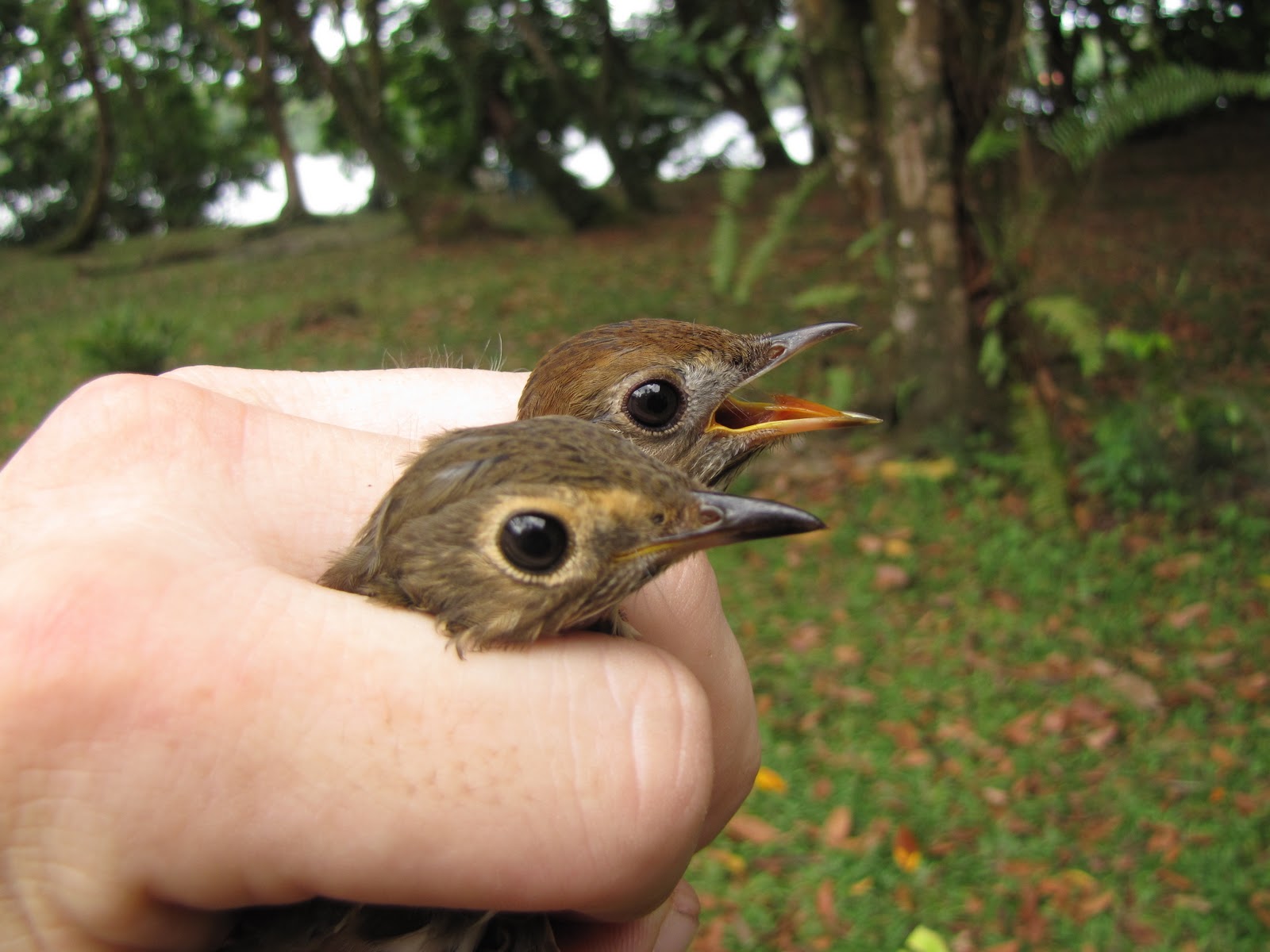
Today I caught a female White-crowned Manakin, Dixiphia pipra. Female manakins are less easy to tell apart than the males, but the grayish head and dark-red iris of the female White-crowned Manakin are distinctive.
Not having seen this bird before, I was curious to find out a bit more about its life history. Apparently, it is a species of lower middle elevations (800 - 1500 m), found from Costa Rica to northeastern Peru and southeastern Brazil (Stiles & Skutch 1989). Another field guide, the more recent Garrigues & Dean (2007), gives 500 - 1500 m as elevational range for this species.
However, I'm here in Tortuguero on the Caribbean coast at 0 m elevation!
And the checklist for Tortuguero (included in Ralph et al. 2008), does not even include this species. It mentions three manakin species, including the similar White-ruffed Manakin (similar in the female plumage, that is), but the female of that species has darker eyes, a greener head, and a lighter throat.
Cited literature:
Garrigues, R. and R. Dean. 2007. The Birds of Costa Rica: a Field Guide. Cornell Univ. Press, Ithaca, NY.
Ralph, C.J., M. Widdowson, B. Widdowson, B. O'Donnell & R.I. Frey. 2008. Tortuguero Bird Monitoring Station Protocol, unpublished draft version January 2008.
Stiles, F. G. and A. F. Skutch. 1989. A guide to the birds of Costa Rica. Cornell Univ. Press, Ithaca, NY.
Labels:
Costa Rica,
Tortuguero,
White-crowned Manakin
Wednesday, November 3, 2010
Catharus mug shots
In the field, spotted Catharus thrushes can sometimes be challenging to identify, especially when the bird is unwilling to allow more than a furtive glance through dense cover. Here at the Tortuguero CCC bird banding station in Costa Rica, these thrushes (especially Swainson's Thrush) are the bread and butter of the banding station this time of year. In the hand, they are surprisingly easy to identify.
I get lots of Swainson's Thrushes (I banded about 30 individuals of this species yesterday morning), some Gray-cheeked Thrushes, and an occasional Veery. Hermit Thrush doesn't come down this far, it winters in the southern and eastern United States, Mexico, Guatemala and western El Salvador. Bicknell's Thrush winters in the Greater Antilles.
At the top, a Swainson's Thrush (left) and Veery (right). Note the difference in tone color and eye ring.
Here, the same duo from above. Even then it is easy to tell which is which.
Here another duo. Our reference bird, the warmer, eye-ringed Swainson's Thrush in back, the colder Gray-cheeked Thrush in front.
Side by side, the differences between these three species are substantial, and immediately obvious.
Subscribe to:
Posts (Atom)