Showing posts with label Bird identification. Show all posts

Tuesday, October 29, 2013

Prairie Merlin: overlooked in Central America?


Sunday morning, I photographed this female or immature Prairie Merlin (Falco columbarius richardsonii) behind our house, on a dirt road that leads to the top of Cerro de Hula. In this plumage they are similar to Taiga Merlins (ssp columbarius), the expected ssp in Central America, but subtly differ in the following aspects: paler overall; rufousy thin breast streaks on a white breast; malar stripe nearly absent; paler mantle. The overcast weather made for a very dark photo. In the field, the bird looked pale.

Two years ago, there was an adult male on the campus of Zamorano University, about 27 km from Cerro de Hula. The weather was about the same that day, i.e. overcast and drizzly, but adult males are a little easier to identify. See this blog entry for a detailed description and photos of that observation, and for a discussion of the regional occurrence of the various Merlin subspecies.

There’s one other record on eBird for the region, from Belize two years ago. That bird was photographed only after it had flown further away from the observers. Although the photo apparently was too distant to be conclusive, the description is convincing. Interestingly, that observation was 5 days apart from ours in Zamorano. The Zamorano bird was not seen again that winter, despite regular coverage. I wonder if our Cerro de Hula bird will stick around.

Prairie Merlins are thought to winter no further south than northwest Mexico, but these reports indicate that small numbers may winter further south than previously thought.

Friday, July 15, 2011

Collared Trogon

Today a photo and video of a Collared Trogon from Montecristo National Park, El Salvador. I just returned from bird monitoring (banding) there, and will be out in the field and away from internet for another week, starting tomorrow morning. This post will be brief.


Collared Trogon is one of the four red-bellied trogons in the region. The male, shown here, is distinguished from males of the other species by its finely barred undertail, and by voice. (From Mountain Trogon also by its leading white edges on the primaries.)

Even the best field guides contain small mistakes or omissions. Take for example Howell & Webb's excellent Guide to Birds of Mexico and Northern Central America. In the Collared Trogon species account, it describes the orbital ring of the male as "orange-red", and notes that the female "lacks bright orbital ring". Many trogon species do have bright orbital rings, and their color is often one of the field marks. In the Collared Trogon, however, there is considerable variation in this feature, and the individual shown above - with a dark orbital ring - is by no means unusual.

Literature cited:
Howell, S. N. G. and S. Webb. 1995. A guide to the birds of Mexico and northern Central America. Oxford Univ. Press, Oxford, UK.

Saturday, December 4, 2010

Mangrove Cuckoo

Mangrove Cuckoo
According to one Costa Rican field guide, Mangrove Cuckoo is an "uncommon to locally fairly common nonbreeding visitor (December—June) in lowlands and foothills of northern Pacific slope, becoming rare south along coast and in Golfo Dulce district; locally to 3600 ft (1100 m) as in western Valle Central; on Caribbean slope regular only in extreme northwest, rarely east to Río Frío region; may breed in very small numbers in lowland Guanacaste" (Stiles & Skutch 1989).

The more recent Garrigues & Dean (2007) summarizes this information, noting the bird is a "fairly uncommon Central American migrant from December to June in northwestern Pacific lowlands; uncommon to rare in southern Pacific lowlands and in western Central Valley."

Not a bird then one would expect on the Caribbean coast.

However, the checklist for Tortuguero, found in Ralph et al. (2008), does list Mangrove Cuckoo as a rare resident.

Mangrove Cuckoo
Here it is, poking its head out of the vegetation. I found this bird on an afternoon walk today near the Mawamba Lodge, a couple of hundred meters from where I'm staying here in Tortuguero (CCC).

Note the all dark upper mandible, the absence of rufous in the wing, the more pronounced dark mask, and the buffy wash on the underparts - all features that distinguish this species from Yellow-billed Cuckoo. There's a difference in the tail pattern also, but these photos don't capture that aspect very well.

Cited literature:
Garrigues, R. and R. Dean. 2007. The Birds of Costa Rica: a Field Guide. Cornell Univ. Press, Ithaca, NY.
Ralph, C.J., M. Widdowson, B. Widdowson, B. O'Donnell & R.I. Frey. 2008. Tortuguero Bird Monitoring Station Protocol, unpublished draft version January 2008.
Stiles, F. G. and A. F. Skutch. 1989. A guide to the birds of Costa Rica. Cornell Univ. Press, Ithaca, NY.

Thursday, November 11, 2010

A very late Sulphur-bellied Flycatcher


Today the banding session here in Tortuguero, Costa Rica began with rain, which was light when I opened the nets but quickly turned to a downpour that lasted for a couple of hours, which had me close them. For a while, it didn't look like I was going to be able to reopen, but around 10 AM, the rain had stopped, so I opened again.

I did not catch very much, but there was a surprise in the form of this very late Sulphur-bellied Flycatcher. Late because this bird, which breeds from southeast Arizona and Mexico down to Costa Rica but winters in South America, is a common passage migrant in Costa Rica from early August to mid-October (Garrigues & Dean 2007, Stiles & Skutch 1989).


Precisely because it is so late, it occurred to me that other Myiodynastes flycatchers, perhaps even South American species, had to be carefully ruled out. Streaked Flycatcher is of course very similar to Sulphur-bellied, and does occur in Costa Rica, even winters here (mostly on the Pacific slope, rare on the Caribbean slope). Obviously we need to start with that bird.


The BNA account for Sulphur-bellied is not very encouraging in this respect, for it claims that Streaked Flycatcher is "often not readily distinguishable in the field". It goes on, however, to list distinguishing field marks: "Streaked is larger with a more robust bill [...], that has extensive pale area at base of lower mandible (dark only on distal half), a narrower dusky malar streak that rarely meets across the chin, which typically is whitish on Streaked and blackish on Sulphur-bellied. [Streaked also with] yellowish-tinged supercilium and mustachial stripes (unlike Sulphur-bellied). [...] Sulphur-bellied also has coarser streaking on underparts; (often) brighter yellow on belly; grayer, less tawny crown; and more whitish edgings on wing coverts (lacks rufous or buff edgings)" (Lowther & Stotz 1999).

With the very notable exception of the coloration of the lower mandible, everything here fits our bird.  While holding the bird in the hand, I noticed the light but extensive yellow on the belly, the dark malar stripe, and the whitish (not creamy) supercilium. For me, it was a Sulphur-bellied Flycatcher. At this point, I was still unaware of a reputed difference in the lower mandible.

But practically every field guide mentions it!

Howell & Webb (1995): "Sulphur-bellied Flycatcher has smaller bill [than Streaked Flycatcher] with little or no flesh below at base."

Stiles & Skutch (1989): "Sulphur-bellied Flycatcher has darker bill, chin and malar area than Streaked Flycatcher, with belly at least as yellow as breast."

Garrigues & Dean (2007): "Streaked Flycatcher very similar in appearance to Sulphur-bellied Flycatcher, but differs in having pink basal half of lower mandible, cream-colored superciliary, thin malar stripe, and whitish belly." (their emphasis)


Pyle (1997) mentions a measurable difference in bill size, which, had I known about it, I would have checked for on this bird. But I only found out after I let it go. He also mentions differences in the width of the streaks in the outer tail feathers, which are <3 mm wide in Sulphur-bellied and >3 mm wide in Streaked Flycatcher. He concludes with differences in malar stripe and chin color, and again with a color difference on the lower mandible: "lower mandible [of Sulphur-bellied Flycatcher] with an indistinct or no pale base (vs base of lower mandible extensively pale pinkish in Streaked Flycatcher)."

There are three more Myiodynastes flycatchers found in South America, but none of them look like this bird. Only Variegated Flycatcher shares some plumage characters, but that bird has a smaller head and a much smaller bill.

Sticking with Sulphur-bellied Flycatcher vs. Streaked Flycatcher, I believe this to be a Sulphur-bellied Flycatcher. All field marks are good for that species, except the coloration of the lower mandible.

As I was preparing this post, I consulted via Skype with Oliver Komar and Carlos Funes of SalvaNATURA. They looked at my photos and compared them with eight photos of Sulphur-bellied Flycatcher in the SalvaNATURA visual database. Six birds showed some pink at the base of the lower mandible, and two almost none. Clearly, this is a variable character, with my bird today likely at the other end of the spectrum.


12 November 2010 postscript:
Here are some photos from Arizona of Sulphur-bellied Flycatchers, including one photo of an individual with about as much light color on the lower mandible as my bird. 
Two photos of Streaked Flycatcher from Peru with a darker lower mandible can be seen here.

Clearly, this character is variable and should not be used to separate the two species.


Acknowledgments:
Thanks to Oliver Komar and Carlos Funes for commenting on this bird, and for comparing photos of other Sulphur-bellied Flycatcher individuals.

Cited literature:
Garrigues, R. and R. Dean. 2007. The Birds of Costa Rica: a Field Guide. Cornell Univ. Press, Ithaca, NY.
Howell, Steve N.G. and Sophie Webb. 1995. A Guide to the Birds of Mexico and Northern Central America, Oxford University Press, Oxford, England. 
Lowther, Peter E. and Douglas F. Stotz. 1999. Sulphur-bellied Flycatcher (Myiodynastes luteiventris), The Birds of North America Online (A. Poole, Ed.). Ithaca: Cornell Lab of Ornithology; Retrieved from the Birds of North America Online: http://bna.birds.cornell.edu/bna/species/475
Pyle, Peter. 1997. Identification Guide to North American Birds, Part 1 Columbidae to Ploceidae. Slate Creek Press, Bolinas, California.
Stiles, F. G. and A. F. Skutch. 1989. A guide to the birds of Costa Rica. Cornell Univ. Press, Ithaca, NY.

Monday, November 8, 2010

Oops!... I did it again


I think I caught another Bicknell's Thrush today!

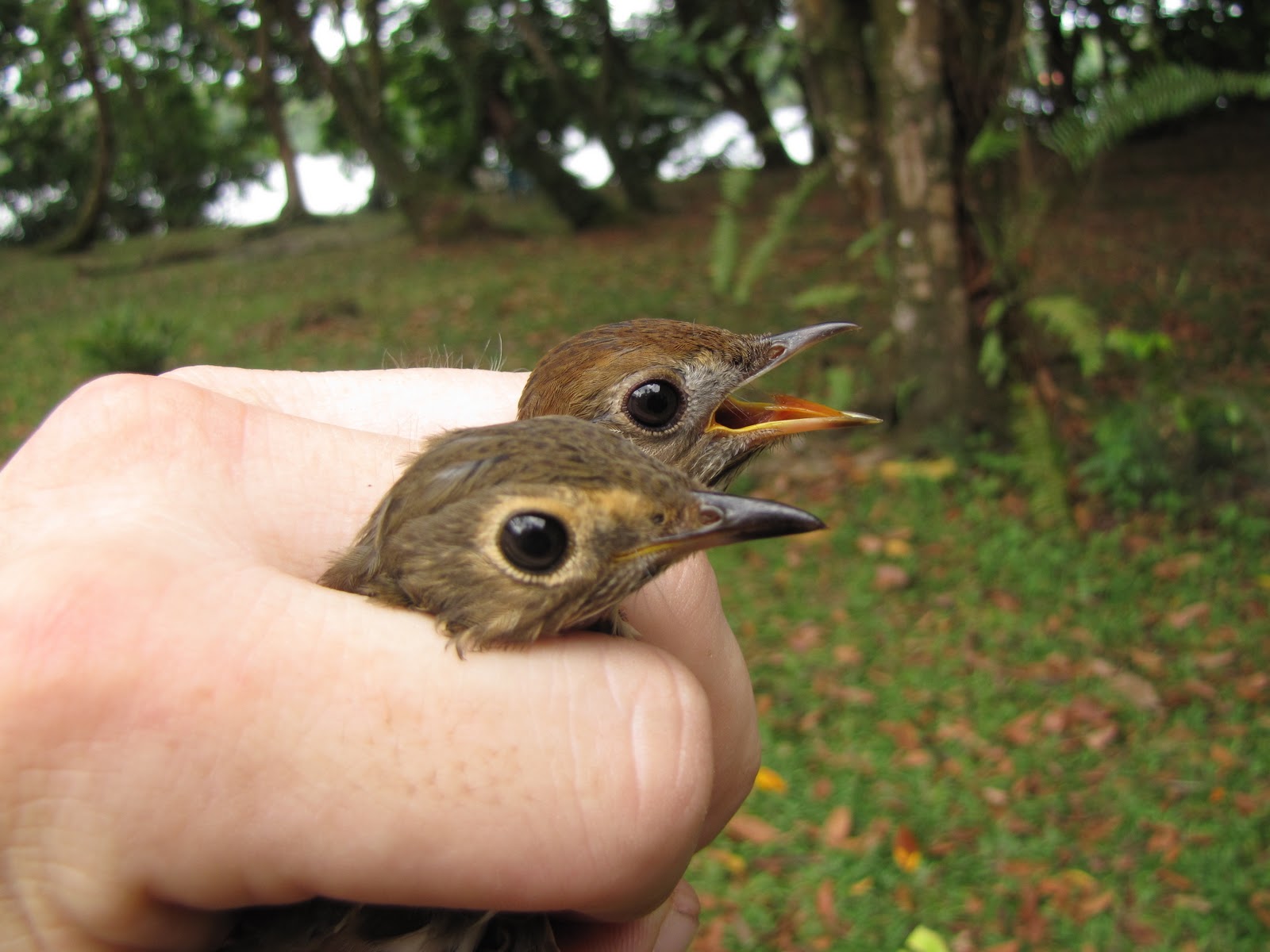
This morning it was obvious that migration was good overnight, for I caught many birds with only a few nets open. The vast majority were Catharus thrushes, with 23 Swainson's Thrushes, 2 Gray-cheeked Thrushes, 1 Veery, and the above individual. For me, this is another candidate for Bicknell's Thrush.


This bird has no obvious eye ring or supraloral mark, so we can quickly rule out Swainson's Thrush. It's not a Veery either, for it lacks the reddish tone on the upperparts, and has more spotting on the breast than Veery does. It could be a Gray-cheeked, except the colors are a little warmer than on the average Gray-cheeked. Also, it has a buffy wash on the throat, unlike Gray-cheeked. And the wing formula seems better for Bicknell's than for Gray-cheeked. (See also previous post for a discussion of this and other characters.)


Then if I tell you that the wing cord was 93 mm (almost too short for Gray-cheeked, about average for Bicknell's) and that the tail measured 61 mm (definitely too short for Gray-cheeked but about average for Bicknell's Thrush), I think you see where I'm going with this!

Another thing I noticed on this bird, having read up on Catharus thrushes since last week's intriguing capture, was the color of the legs. Pyle mentions for Bicknell's Thrush "legs flesh with a purplish tinge or a brownish-dusky wash, darker than toes" while his description of the Gray-cheeked Thrush's legs is "pale flesh with a dusky wash, paler than the toes" (Pyle 1997). In the hand, I did see a purplish tinge, and while I didn't take any photos of the legs specifically, I think we can appreciate in the third photo that the toes of this bird are lighter than the legs.

Obviously, this time I did collect a tail feather, and you can see quite well which one it is, from the third photo.

It will very likely be months at the very least before the feather has been analyzed, and we have a bit more certainty which species this is.

Assuming for a minute that both birds really were Bicknell's Thrushes, could it be that this species has been under-reported in Central America? Another, perhaps more likely possibility is that a small percentage of Catharus thrushes cannot safely be identified to species, even in the hand.


Another surprise find today was this bird, White-throated Thrush. Normally a middle elevations species (like the White-crowned Manakin of last week), not a bird expected at sea level. Like the manakin, this bird is not listed on the checklist included in the banding protocol for the site (Ralph et al. 2008), although both Stiles & Skutch (1989) and Garrigues & Dean (2007) mention post-breeding altitudinal migration in this species.

Cited literature:
Garrigues, R. and R. Dean. 2007. The Birds of Costa Rica: a Field Guide. Cornell Univ. Press, Ithaca, NY.
Pyle, Peter 1997. Identification Guide to North American Birds, Part 1 Columbidae to Ploceidae. Slate Creek Press, Bolinas, California.
Ralph, C.J., M. Widdowson, B. Widdowson, B. O'Donnell & R.I. Frey. 2008. Tortuguero Bird Monitoring Station Protocol, unpublished draft version January 2008.
Stiles, F. G. and A. F. Skutch. 1989. A guide to the birds of Costa Rica. Cornell Univ. Press, Ithaca, NY.

Friday, November 5, 2010

Bicknell's Thrush!


Two days ago, I caught what I think will easily be the hottest capture of the season: a Bicknell's Thrush! If accepted, this would represent not only a first record for Costa Rica, but for all of Central America!

Casually looking at it as I pulled it out of the net, I thought it was a Gray-cheeked Thrush - after Swainson's Thrush the second most common spotted Catharus thrush here in Tortuguero, Costa Rica. While processing the bird, however, I quickly noticed it was different from that species in several ways.

For starters, the wing cord was exceedingly short: 93 mm. Most Gray-cheeked Thrushes have a wing cord of >97 mm, many >100 mm. In fact, the whole bird was small, with a tail coming in at 65 mm (63-97 mm for Gray-cheeked; 59-74 mm for Bicknell's, according to Pyle). The body mass was 27.0 g. Then I noticed how warm the colors were compared to the average Gray-cheeked. I further noticed a contrast between the tail and the back. The bird also showed a buffy wash on the throat, unusual for Gray-cheeked.


Realizing I was holding a Catharus thrush that didn't easily fit into one of the three species found here (Swainson's, Gray-cheeked and Veery), I decided to consult Pyle (1997) and check for Bicknell's Thrush.

Summarizing, I found that everything about this bird appeared good for Bicknell's, although some characters can also be shown by a minority of Gray-cheeked Thrushes.

I photographed the bird extensively (but in the excitement forgot to collect a tail feather), and when my banding shift was over, decided to consult with Peter Pyle directly through email. He agreed with me that the bird looks good for Bicknell's Thrush, but added that he himself has no personal experience with this species. He forwarded my photos and measurements to someone with that experience.

He did add that the fact that P7 appears to be the longest primary may be important. The illustrations in his Identification Guide had already drawn my attention to differences in wing formula, so I photographed that aspect of the bird as well as I could.

Compare and contrast the next two photos; first the putative Bicknell's Thrush, next a Gray-cheeked Thrush in a similar posture.  Both are HY birds, caught within days here in Tortuguero, Costa Rica.

Thrushes have 10 primaries, with the 10th reduced (Pyle 1997). So the outermost 'large' primary feather is P9. Note how P8 is the longest feather in the Gray-cheeked's wing, with P9 almost as long (below), while in our Bicknell's candidate (above), P9 and P8 are both shorter, and the longest feather is P7. Thus the wing is rounder, less pointed than that of Gray-cheeked Thrush.


Here again is that Bicknell's Thrush' wing, with the appropriate page in Pyle as a background.


If accepted, this would be the first time, as far as I'm aware, that this species has been recorded in Central America. It breeds in southeast Quebec and the Maritime Provinces of Canada, and eastern New York and northern New England, USA. Its wintering grounds are found in the Greater Antilles, particularly the Dominican Republic. There are three records from Cuba (BirdLife International 2008).

Since this is not an easy species to identify, I'm hoping my documentation will stand up to further critical attention. With Bicknell's Thrush's IUCN status as Vulnerable and its population trend Decreasing (BirdLife International 2008), this capture is likely to garner some attention.

Cited literature:
BirdLife International 2008. Catharus bicknelli. In: IUCN 2010. IUCN Red List of Threatened Species. Version 2010.4.  <www.iucnredlist.org> Downloaded on 5 November 2010.
Pyle, Peter 1997. Identification Guide to North American Birds, Part 1 Columbidae to Ploceidae. Slate Creek Press, Bolinas, California.

Postscript 6 November 2010:
One of the Bicknell's Thrush researchers, currently in the field in the Dominican Republic studying Bicknell's Thrushes, comments that there may have been a previous Costa Rica record from 2009 or 2008. He also writes that my documentation will be further studied and that he will get back to me at the next opportunity with an informed opinion. If this turns out to be the second recent record for Costa Rica, I would personally find that even more interesting. It would be a stronger clue for possible range extension, rather than a record of a lone disoriented individual.

Wednesday, November 3, 2010

Catharus mug shots


In the field, spotted Catharus thrushes can sometimes be challenging to identify, especially when the bird is unwilling to allow more than a furtive glance through dense cover. Here at the Tortuguero CCC bird banding station in Costa Rica, these thrushes (especially Swainson's Thrush) are the bread and butter of the banding station this time of year. In the hand, they are surprisingly easy to identify.

I get lots of Swainson's Thrushes (I banded about 30 individuals of this species yesterday morning), some Gray-cheeked Thrushes, and an occasional Veery. Hermit Thrush doesn't come down this far, it winters in the southern and eastern United States, Mexico, Guatemala and western El Salvador. Bicknell's Thrush winters in the Greater Antilles.

At the top, a Swainson's Thrush (left) and Veery (right). Note the difference in tone color and eye ring.


Here, the same duo from above. Even then it is easy to tell which is which.


Here another duo. Our reference bird, the warmer, eye-ringed Swainson's Thrush in back, the colder Gray-cheeked Thrush in front.


Side by side, the differences between these three species are substantial, and immediately obvious.

Monday, October 11, 2010

Dots

A couple of posts ago, I grumbled about having seen so little hawk migration thus far in El Salvador.

Last Saturday, Roselvy and I went to a Maya archaeological site called San Andrés, in the Valley of Zapotitán, more or less halfway between San Salvador and Santa Ana. Here, we found beauty, tranquility and, atop "Estructura 4", a 360° view of the sky.

Structure 4 is the hill on the far right in this picture, behind the little tree. The other three hills are Structures 1, 2 and 3, which are off limits. Although not as impressive as Tikal in Guatemala or Copán in Honduras, San Andrés is an interesting place to visit, with remains of human habitation dating back 3000 years. Situated in the Central American Volcanic Belt, its history is one of settlements establishing themselves, growing, flourishing, and then being wiped out by a volcanic eruption, before the whole process starts again.

Between 10 AM and 4 PM, we watched thousands of raptors, mostly hawks and vultures, stream high overhead. In the morning, the flight was dominated by Swainson's Hawks, which can be seen in the picture at the very top. A few broadwings are also visible in that photo.

Turkey Vulture and Broad-winged Hawk were the other two abundant species, both of which can be seen in this picture if you click on it. The hawk on the left is something else, and if you want to try and identify it for yourself, go right ahead. I'll tell you what it is a little further down in this post.

In the afternoon, the flight was dominated by Turkey Vultures, with thousands streaming over. Scattered among them were Broad-winged Hawks, eight of which can be seen in this picture.

Other migrant hawks we noted were Zone-tailed Hawk (2), Mississippi Kite (12), American Kestrel (1) and Sharp-shinned Hawk (1). With non-migratory, resident raptor species Northern Caracara, Short-tailed Hawk and Roadside Hawk, we got to 11 diurnal raptors, two vulture species included. The 'mystery hawk' in the third photo of course is a Zone-tailed Hawk. Only superficially similar to Turkey Vulture, the bird stands out as different from TV's in a number of ways: wingtips pointier and swept back, tail longer and thinner, head bigger. In this photo, the zone-tail looks a lot smaller than the Turkey Vultures, but that's partly because it is flying higher.

To get a sense of where we were seeing all these birds, here is a relief map of western El Salvador. Right in the middle, below a small crater, is San Salvador. The crater belongs to Volcán de San Salvador. The two yellow cards halfway between that crater and a crater lake, called Lago Coatepeque, identify two archaeological sites, one of which is San Andrés.

We saw birds flying mostly due east, which would bring them a little north of Volcán de San Salvador. I posted our sightings to the national birding listserv here in El Salvador, and this yielded a couple more descriptions from people who had seen the same thing.

Friday, September 17, 2010

Green-breasted Mountain-gem

Green-breasted Mountain-gem - Lampornis sybillae adult male


In today's post we're taking a closer look at the Green-breasted Mountain-gem, a hummingbird species that is found in central Honduras (east of the Sula Valley) and northwestern Nicaragua. Closely related to the parapatric Green-throated Mountain-gem, which occurs in Honduras west of the Sula Valley and in northern El Salvador, Guatemala and southeastern Mexico, it is separated from that species by more extensive green mottling on the breast in males, a buffy wash on the throat and more green mottling on the sides of the breast in females, and more contrasting white on the outer tail feathers in both sexes.

Green-breasted Mountain-gem - Lampornis sybillae adult male


Adult male Green-breasted Mountain-gems are stunningly beautiful creatures, whose iridescent throat and breast feathers channel a dull green, or a bright aquamarine or light blue, depending on the angle of the sunlight and the position of the viewer.

Green-breasted Mountain-gem - Lampornis sybillae adult male


Mountain-gems, in the genus Lampornis, are fairly large hummingbirds, one species of which just barely reaches into the United States: the Blue-throated Hummingbird. They are generally associated with highlands, especially cloud forest, and are found throughout Central America. Currently, seven species are recognized, although some work, using mitochondrial and nuclear DNA sequencing, remains to be done on the taxonomy of this genus.

Green-breasted Mountain-gem - Lampornis sybillae young male


Here's a young male, with more or less complete greenish mottling on the throat and breast, like an adult. Both males and females soon after fledging acquire an adult-like plumage, but can still be aged by the presence of buffy edges to the dark green upper head and back feathers, and by the amount of bill striations, or bill corrugations.

Click on this photo for an enlarged view, and you'll notice this bird shows some buffy edges on the head feathers.

Along the side of the bill, little corrugations can be seen that are typical of young hummingbirds. They lose these striations as they get older, and the bill gets harder and smoother. Some adults retain up to 10% of bill striations. The bird in the photo above has a bill striations score of about 60%, and so is very likely a hatch year bird. For some northern species, for example Anna's Hummingbird and Rufous Hummingbird, the timing or rate of this process of bill smoothing is known, and the percentage of bill striations can thus be used to reliably age individuals of those species (see for example Yanega et al. 1997).

In tropical species, however, much remains to be learned about the rate of this process. I'm currently working on a paper about the Green-breasted Mountain-gem's sister species, the aforementioned Green-throated Mountain-gem. In this species, it appears that bill smoothing takes more than one year to complete. Bird banders working in the tropics are thus advised to exercise caution when using rate of bill striations for ageing hummingbirds.

Green-breasted Mountain-gem - Lampornis sybillae adult female


This is an adult female, with a buffy wash on the throat. Females of the more northerly/westerly sister species Green-throated Mountain-gem have white throats, while females of the more southerly/easterly White-throated Mountain-gem have orange throats. Geographically located between these two extremes, the female Green-breasted Mountain-gem appears to be intermediate in that particular aspect also.

Note that this bird has a modest amount (<10%) of bill striations near the base of the bill.

Green-breasted Mountain-gem - Lampornis sybillae adult female


Here an unusually pale-throated female Green-breasted Mountain-gem. A small percentage of females will look like this, approaching Green-throated Mountain-gem in this feature. Note however the green mottling on the sides of the breast and belly; in female Green-throated Mountain-gems, the green mottling generally does not extend beyond the sides of the upper breast.

Note that this bird has no bill striations, but a small abrasion on the distal part of the bill, a mark that's probably the result of some external impact.


Green-breasted Mountain-gem - Lampornis sybillae adult female

And here a top view of the same bird, showing the whitish outer tail feathers, a field mark good for Green-breasted, not Green-throated Mountain-gem. Note that the right outer tail feather is cut. We do this to mark individuals. Special permits are required for hummingbird banding.

All these photos were taken this past week in Reserva Biológica Monte Uyuca, Honduras. I was there to band birds with the banding crew of SalvaNATURA, a conservation NGO for whom I'm currently volunteering. If you want to learn more about the valuable work we do in SalvaNATURA's bird monitoring program, then please visit Maratón de Aves El Salvador / Birdathon 2010 and consider sponsoring the birdathon, which I have the honor of organizing this year. All funds collected in this 8th edition of the birdathon will go toward SalvaNATURA's bird monitoring project. Your contribution will be greatly appreciated.

Cited literature
Yanega, Gregor M., Peter Pyle & Geoffrey R. Geupel 1997. The timing and reliability of bill corrugations for ageing hummingbirds. Western Birds 28: 13-18.

Monday, February 15, 2010

Ring-billed Gulls

Today we're taking a closer look at one of the most common, most easily observed North American birds, the Ring-billed Gull. Somebody was feeding these birds yesterday on the Inwood Hill Park Bay, providing me with close range photo opportunities. Practically anyone in North America can easily observe these birds most of the year, and if you've done so extensively, this post is probably not going to show you anything you didn't already know.

It's a three-year gull, meaning the bird goes through three plumage cycles to reach the adult basic (non-breeding) or alternate (breeding) plumages.

This is a first cycle bird. The eyes are dark; the bill and legs are pinkish; the black on the bill hasn't become a ring yet; the majority of the mantle feathers are brown; the tail is white with a broad black band. Some brown juvenal feathers are being replaced by grey second cycle feathers, such as the mantle feathers and tertials.

Same individual. Note the brown smudges all over the head and neck. In winter, first and second cycle birds show such extensive mottling, while adults in basic (winter) plumage show limited mottling on the head. See for example the middle bird in the top picture.

Still the same individual, photographed merely seconds after the previous photo was taken. Plumage-wise we're not seeing anything different, but note how the head shape is subtly different now that the bird is more alert. In larophology, larophiles often stress the shape and structure of the bird, because plumage is so tremendously variable in this family. This may be true, but so is shape!

Here's a head detail of a second cycle bird. The bill now has a ring, and the tip of the bill is already yellow. The proximal part of the bill is now greenish gray. Note that there is considerable variation in coloration of bare parts also, so not every second cycle ringbill is going to show a gray bill in winter.

Same bird. Not only the bill is gray - so is the eye. The spotting on the head and neck seems less than on the first cycle bird, but more than on the basic plumage bird. Although this bird is intermediate in age class, I don't think the intermediate spotting is age-related; I believe it to be rather a function of individual variation. Anyone wishing to correct me on this, please do!

Again the same bird. Note how this second cycle plumage resembles the basic plumage. Two major differences are obvious in this photo: color of bare parts, and absence of white spots in the wings. The birds standing behind the second cycle bird are both in basic plumage, with yellow, not gray legs, and with white spots in the wingtips.

All these birds were photographed 14 February 2010 in Inwood Hill Park, Manhattan. The previously reported ringbill with an auxiliary marker (APP) was still present. I haven't heard back yet where this bird was banded.

Friday, February 5, 2010

Plumage details

Our Golden-cheeked Warbler field work in Honduras is done. We described 25 insectivorous mixed-species flocks at 5 different pine-oak forest locations throughout the country, and encountered 32 individual Golden-cheeked Warblers. Some of them were outside the flocks we described. A scientific paper describing the results of our field work and that from four other Central American countries is in preparation. Without going into too much detail, I can report for Honduras that the vast majority of the birds we saw this year were adult males. Most were first seen in a thin-leaved oak species called Quercus sapotifolia - clearly a favorite foraging tree species for Golden-cheeked Warblers on the wintering grounds. Practically every photo I've posted here of goldencheeks shows them in this oak species.

Throughout this season and the previous winter, I have talked here in this blog about plumage details of Golden-cheeked Warblers: how to separate this species from closely related warblers, and within the species how to distinguish the various sex and age classes.

Let's take that last subject to another level. I believe the bird pictured above is an adult male, most likely a second-year male.

In this photo of the same bird, the throat and chin appear solid black, while the eye stripe also appears black or blackish. These are field marks for an adult male Golden-cheeked Warbler. Females have a yellowish or whitish upper chin, while the chins and throats of immature males tend to be black with whitish feather tips.

But look more carefully at the top photo. One of things that's notable in that photo is that the mantle or upperparts are not entirely black. The crown and eye stripe appear black, but the mantle seems dark olive with thick black streaks. That last field mark is better for adult female or a younger male. Adult females and first winter males, however, don't have black chins.

Here's another photo that shows the mantle. Again, the mantle appears dark olive with broad black streaks - not black.

Also, in the lower white wing bar on the median coverts we see dark shaft streaks. These wing bars are completely white on adult males only.

So what we have here is a bird that shows some field marks for an adult male, and some for a younger bird.

Now take a look at this one. Here the sunlight hits the bird sideways, and as we saw earlier, the black on the throat goes up all the way to the chin. However, now we also see some yellow feathers in there that were practically invisible from other angles, for example in the second photo from the top. All these photos are of the same individual. (Go back to that second photo, click on it for a larger view, and you will see a hint of yellowish on the throat...)

I photographed this bird in the morning of January 31, 2010 near Monte Uyuca in Honduras. Over lunch that day, I looked at these photos with my field assistants Kashmir and Fabiola, and with Salvadoran banders Roselvy and Lya. For Roselvy, one of the most experienced banders in Central America and someone well versed in the subtle art of looking at plumage details on warblers, it was clear that this bird had to be a second year male.

During previous field seasons, I sometimes wondered whether it's really possible to separate immature males from adult females in the field. This year, with more field experience with the species, I felt more comfortable assigning sex and age classes to the birds we saw. In some cases, we saw the bird only briefly or from a distance, but in most cases we were able to observe the birds for extended periods of time and from various angles. Paying close attention to plumage details helped us separate different individuals in the same warbler flock, even if we didn't get the opportunity to see them feeding side by side.

This weekend I'm set to count shorebirds in western El Salvador. This will be the fourth year of this count, and the second year of my participation in it. This shorebird count is organized by the Salvadoran Ministry of Environmental Affairs, and each year is repeated in April. I'm hoping our team - Roselvy, Karla and me - will find some interesting species! We're going to do this without a telescope, only binoculars, so finding the rarer species will be quite a challenge...

Shorebirding is very different from following a mixed warbler flock in a forest, yet here too it pays to look for plumage details, as well as structure and behavior. Monday I'll be traveling, but I should be able to post some shorebird photos around mid-week.

Wednesday, April 1, 2009

Which accipiter is this?

Lately I've been enjoying blogging here about ID questions, like with the redpolls recently. However, I don't consider myself an ace birder who needs to show off his identification skills - God no. These ruminations are as instructive to myself as I hope they may be to some of my readers. I certainly learned stuff about redpoll identification that I didn't know before.

North American raptor identification is perhaps different, because I am supposed to be somewhat of an expert on that. After all, I have been hired to count migrating raptors for six consecutive migration seasons, all over North America. If I didn't know a thing or two about raptor identification by now, I'd better move on to something else. But after six field seasons I still feel I am learning about raptors, although I've probably mastered the basics.

And these days there are many people who know their hawks. It's never been easier to get proficient in raptor identification, for it has come a long way in North America. Books like Hawks in flight (Dunne, Sibley & Sutton 1988) and more recently Hawks from every angle (Liguori 2005) have helped hawk watchers across the continent tremendously. Of course, nothing substitutes for sheer field experience.

The classic ID challenge remains between that of separating female Sharp-shinned Hawks from male Cooper's Hawks. In the days of the first Peterson Guide, this was thought to be practically impossible in the field, and really the best way to do it was to shoot the bird. We now know how to go about separating those two species, even under difficult viewing conditions, without having to shoot them. We tend to think that separating Cooper's Hawk from Northern Goshawk is easier - and usually it is.

Let's move on to the problem at hand. It probably goes without saying that the bird pictured above is a juvenile accipiter. But which one? Photo taken on March 31, 2009 at Whitefish Point, northern Michigan.

It may be difficult to get a sense of the relative size of this bird, just on the basis of this picture alone. In the field, such things are much more apparent, for example by wing action. This bird was close, and it was large. Not a sharpshin then, if that was even a consideration.

So we've narrowed this down to immature Cooper's Hawk vs immature Northern Goshawk. That was relatively easy; from this point forward, things become considerably more difficult!

Looking at plumage, we notice that the streaking on the body is rather fine, and doesn't extend all the way down. The undertail coverts appear unmarked. Both these things are good for Cooper's Hawk, not for the typical goshawk.

What about the tail? Relatively thin, it seems - another point for Cooper's Hawk. Tip not very rounded and without a broad white tip. But remember: this is a spring individual, with a worn tail. Most accipiter tails look like this in spring. Tail shape and presence/absence of a terminal white tail band is a more useful field mark on fresh tails in fall. So this tail certainly could be a Cooper's tail, despite the fact that it's not round and doesn't have a white terminal band.

What about the 'wavy pattern' on tail bands? This is a well-known diagnostic trait of immature goshawks. It would have been easier to judge on an open tail, but click on the photo and see if you can spot some wavy patterning on the tail. I can. Let's chalk it up as a tentative plus for gos, while acknowledging that we can't see it well enough to be absolutely certain.

One field mark for separating gos from coop, mentioned in Dunne, Sibley & Sutton, appears to have lost some currency, for it is not found in any of the later references, like Wheeler (2003) or Liguori (2005): number of tail bands. In classic cocky Pete Dunne style, he says "if you are close enough to see a zigzag pattern, why not just count the tail bands? Goshawks show four, Cooper's only three." I went back and applied this formula to birds photographed for both the Wheeler and Liguori guides, and it works most of the time on uppertails, but practically never on undertails. I don't want to sidetrack too much here, but plate 190 in Wheeler (2003) for example shows an immature Cooper's Hawk upperside with four bands clearly visible. Undertails is a different matter probably, because undertail coverts only partially obscure the inner tail bands, so you're left wondering which ones to count.

Let's also consider head projection. The neck on this bird does not seem particularly long: a point against Cooper's Hawk and in favor of goshawk. Do we see a white supercilium? It looks like there's something there, but it's really hard to judge from this angle.

Below I have more photos of the same bird, but before we look at those, let's try to finish the ID of this bird on the basis of the top photo alone.

Liguori (2005) makes much of 'hand projection': the way the primaries seem to stick out on a partially folded wing. Based on the top photo, hand projection does not seem very pronounced from that angle. Slight plus for coop then.

I think I see a facial disk. Liguori (2005) says about this: "Northern Goshawks also have pale auriculars that form a fairly defined facial disk." About the pale supercilium he says that "although juvenile Sharp-shinned and Cooper's Hawks can exhibit a pale superciliary, the superciliary of juvenile goshawks is always prominent." The pale supercilium (or superciliary, same thing) appears to be there but is hard to see from this angle. The facial disk is better visible.

Summarizing what we have so far, and feel free to disagree with me:
  • unstreaked undertail coverts: better for coop
  • long, thin tail: better for coop
  • wavy pattern on tail bands: better for gos (but difficult to judge in photo)
  • head projection: better for gos (because limited)
  • hand projection: better for coop
  • supercilium: better for gos (but difficult to judge in photo)
  • facial disk: better for gos
As you can see, my scale is ever so slightly tipping over towards gos, and that's what I called it in the field (and also on WPBO's hawk blog).

Now let's look at those other photos, and see if we can finish the identification. Note that those aren't half as good as the top photo, but they are all the same individual. Click on them for larger views.

Here's the bird coming up to the hawk platform. Chesty? Yes, I think so. Long projection of hand? In this photo: yes, actually. White supercilium? Yup. All three field marks are good for goshawk.

Positively pot-bellied, I'd say. White supercilium and facial disk also clearly visible in this shot.

This angle provides another opportunity for judging head projection, tail length and width, hand projection, and body width.

And finally, a shot of the bird flying away. Note the mottled upperparts, and the four tail bands.

New Jersey Audubon sells bumper stickers with the phrase "What Would Pete Dunne Do?" Well, in this case I'm sure he would count the tail bands.

Would he call it a Northern Goshawk? I don't know, but I do. What do you think?

References
Dunne, P., Sibley, D. & Sutton, C. (1988) Hawks in flight. Houghton Mifflin, Boston.
Liguori, J. (2005) Hawks from every angle. Princeton University Press. Princeton.
Wheeler, B.K. (2003) Raptors of Eastern North America. Princeton University Press, Princeton.