Tuesday, November 9, 2010
Chestnut-sided Warbler
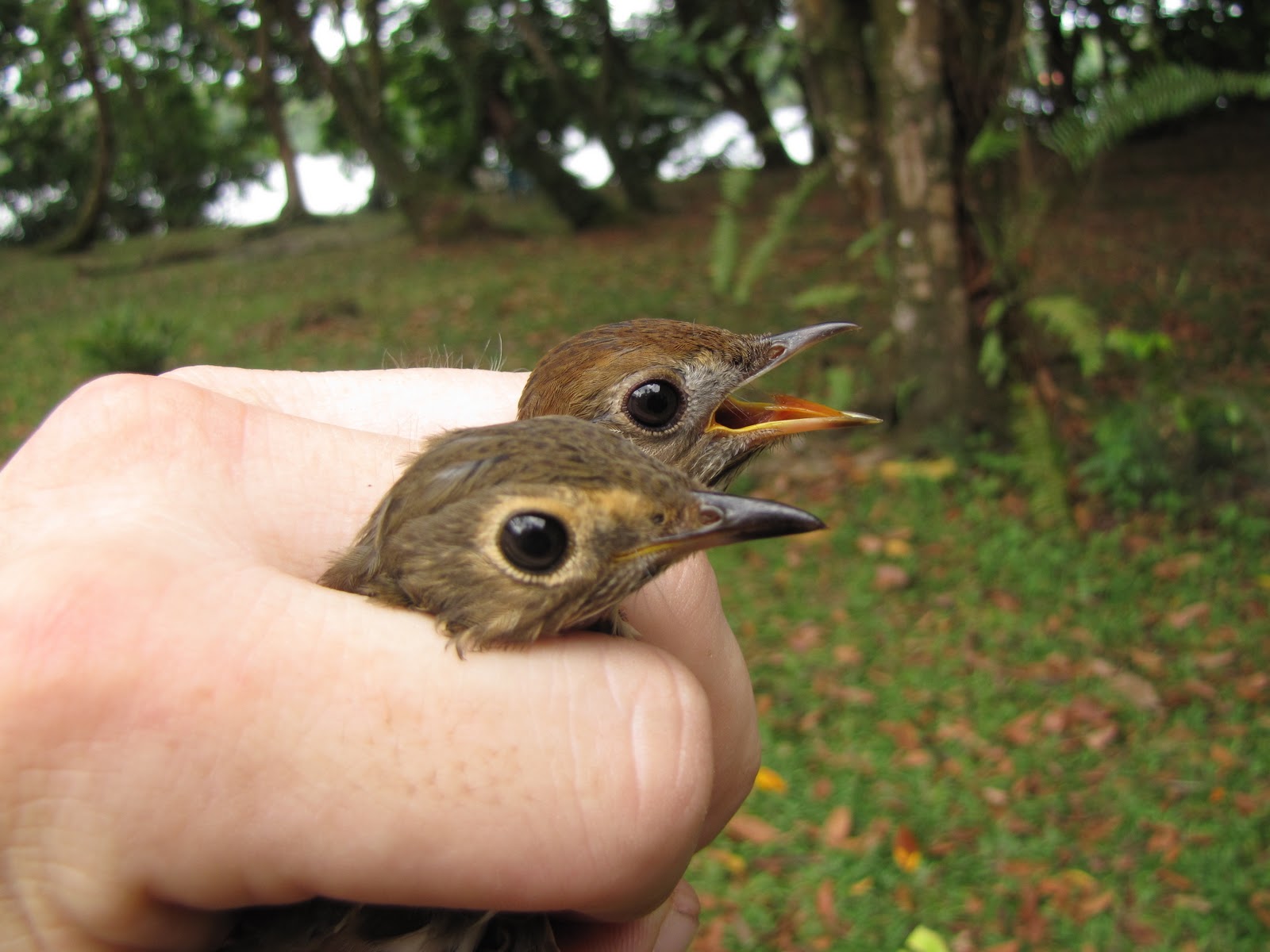
Today, I had two Chestnut-sided Warblers side by side in the net. That in itself is not so remarkable, given how common they are here in Tortuguero, Costa Rica, as migrants and winter visitors. I see these birds practically every day, usually a little higher in the canopy. I don't catch them very often.
In fact, since I've been here, I've only caught two individuals before these two. One was on the 21st of October, my first day of banding here. The other was on the 29th of October. That second bird got out of the net on its own, before I could extract it.
What is remarkable about today's capture, however, is that one of the birds was already banded - and it wasn't the October 21 bird! Unfortunately, I don't have access to the banding database of this site, so I cannot yet be 100% sure of this, but I think this may be a recapture from somewhere else!
As you can see when you click on the photo, the band ends in a 6. The full band code was 211094346. I looked at the (paper) banding records going back to 16 October 2010, when Evan Adams started banding here, and I do not find any record of this band. In fact - and here's the kicker - I do not find any 0 or similar sized band records that start with 211!
This last bit of evidence tells me that the series from which this band came is not from here. I aged the bird as a HY (hatch year) bird, based on a molt limit visible in the primary coverts. So, unless I am very much mistaken, this bird was very likely banded somewhere else earlier this year!
If so, it would be a great capture, for this is really why we band birds in the first place. But again, just like the recent putative Bicknell's Thrush captures, we won't know for sure until later. I'll have to check with the site coordinator whether this is really a recapture from someplace else. If so, it will likely take a bit more time before we know where it was banded.
Postscript 24 November 2010:
This bird was banded right here in Tortuguero in October 2008! Not a hatch year bird then; I still need a lot more experience ageing warblers, which is more difficult than, say, thrushes. But the recapture, two years later, seems to imply either winter site fidelity or, at the very least, a preference for using the same migration route among years. A third capture outside migration season would clinch it. But what are the odds of that?
Labels:
Chestnut-sided Warbler,
Costa Rica,
Tortuguero
Monday, November 8, 2010
Oops!... I did it again
I think I caught another Bicknell's Thrush today!
This morning it was obvious that migration was good overnight, for I caught many birds with only a few nets open. The vast majority were Catharus thrushes, with 23 Swainson's Thrushes, 2 Gray-cheeked Thrushes, 1 Veery, and the above individual. For me, this is another candidate for Bicknell's Thrush.
This bird has no obvious eye ring or supraloral mark, so we can quickly rule out Swainson's Thrush. It's not a Veery either, for it lacks the reddish tone on the upperparts, and has more spotting on the breast than Veery does. It could be a Gray-cheeked, except the colors are a little warmer than on the average Gray-cheeked. Also, it has a buffy wash on the throat, unlike Gray-cheeked. And the wing formula seems better for Bicknell's than for Gray-cheeked. (See also previous post for a discussion of this and other characters.)
Then if I tell you that the wing cord was 93 mm (almost too short for Gray-cheeked, about average for Bicknell's) and that the tail measured 61 mm (definitely too short for Gray-cheeked but about average for Bicknell's Thrush), I think you see where I'm going with this!
Another thing I noticed on this bird, having read up on Catharus thrushes since last week's intriguing capture, was the color of the legs. Pyle mentions for Bicknell's Thrush "legs flesh with a purplish tinge or a brownish-dusky wash, darker than toes" while his description of the Gray-cheeked Thrush's legs is "pale flesh with a dusky wash, paler than the toes" (Pyle 1997). In the hand, I did see a purplish tinge, and while I didn't take any photos of the legs specifically, I think we can appreciate in the third photo that the toes of this bird are lighter than the legs.
Obviously, this time I did collect a tail feather, and you can see quite well which one it is, from the third photo.
It will very likely be months at the very least before the feather has been analyzed, and we have a bit more certainty which species this is.
Assuming for a minute that both birds really were Bicknell's Thrushes, could it be that this species has been under-reported in Central America? Another, perhaps more likely possibility is that a small percentage of Catharus thrushes cannot safely be identified to species, even in the hand.
Another surprise find today was this bird, White-throated Thrush. Normally a middle elevations species (like the White-crowned Manakin of last week), not a bird expected at sea level. Like the manakin, this bird is not listed on the checklist included in the banding protocol for the site (Ralph et al. 2008), although both Stiles & Skutch (1989) and Garrigues & Dean (2007) mention post-breeding altitudinal migration in this species.
Cited literature:
Garrigues, R. and R. Dean. 2007. The Birds of Costa Rica: a Field Guide. Cornell Univ. Press, Ithaca, NY.
Pyle, Peter 1997. Identification Guide to North American Birds, Part 1 Columbidae to Ploceidae. Slate Creek Press, Bolinas, California.
Ralph, C.J., M. Widdowson, B. Widdowson, B. O'Donnell & R.I. Frey. 2008. Tortuguero Bird Monitoring Station Protocol, unpublished draft version January 2008.
Stiles, F. G. and A. F. Skutch. 1989. A guide to the birds of Costa Rica. Cornell Univ. Press, Ithaca, NY.
Friday, November 5, 2010
Bicknell's Thrush!
Two days ago, I caught what I think will easily be the hottest capture of the season: a Bicknell's Thrush! If accepted, this would represent not only a first record for Costa Rica, but for all of Central America!
Casually looking at it as I pulled it out of the net, I thought it was a Gray-cheeked Thrush - after Swainson's Thrush the second most common spotted Catharus thrush here in Tortuguero, Costa Rica. While processing the bird, however, I quickly noticed it was different from that species in several ways.
For starters, the wing cord was exceedingly short: 93 mm. Most Gray-cheeked Thrushes have a wing cord of >97 mm, many >100 mm. In fact, the whole bird was small, with a tail coming in at 65 mm (63-97 mm for Gray-cheeked; 59-74 mm for Bicknell's, according to Pyle). The body mass was 27.0 g. Then I noticed how warm the colors were compared to the average Gray-cheeked. I further noticed a contrast between the tail and the back. The bird also showed a buffy wash on the throat, unusual for Gray-cheeked.
Realizing I was holding a Catharus thrush that didn't easily fit into one of the three species found here (Swainson's, Gray-cheeked and Veery), I decided to consult Pyle (1997) and check for Bicknell's Thrush.
Summarizing, I found that everything about this bird appeared good for Bicknell's, although some characters can also be shown by a minority of Gray-cheeked Thrushes.
I photographed the bird extensively (but in the excitement forgot to collect a tail feather), and when my banding shift was over, decided to consult with Peter Pyle directly through email. He agreed with me that the bird looks good for Bicknell's Thrush, but added that he himself has no personal experience with this species. He forwarded my photos and measurements to someone with that experience.
He did add that the fact that P7 appears to be the longest primary may be important. The illustrations in his Identification Guide had already drawn my attention to differences in wing formula, so I photographed that aspect of the bird as well as I could.
Compare and contrast the next two photos; first the putative Bicknell's Thrush, next a Gray-cheeked Thrush in a similar posture. Both are HY birds, caught within days here in Tortuguero, Costa Rica.
Thrushes have 10 primaries, with the 10th reduced (Pyle 1997). So the outermost 'large' primary feather is P9. Note how P8 is the longest feather in the Gray-cheeked's wing, with P9 almost as long (below), while in our Bicknell's candidate (above), P9 and P8 are both shorter, and the longest feather is P7. Thus the wing is rounder, less pointed than that of Gray-cheeked Thrush.
Here again is that Bicknell's Thrush' wing, with the appropriate page in Pyle as a background.
If accepted, this would be the first time, as far as I'm aware, that this species has been recorded in Central America. It breeds in southeast Quebec and the Maritime Provinces of Canada, and eastern New York and northern New England, USA. Its wintering grounds are found in the Greater Antilles, particularly the Dominican Republic. There are three records from Cuba (BirdLife International 2008).
Since this is not an easy species to identify, I'm hoping my documentation will stand up to further critical attention. With Bicknell's Thrush's IUCN status as Vulnerable and its population trend Decreasing (BirdLife International 2008), this capture is likely to garner some attention.
Cited literature:
BirdLife International 2008. Catharus bicknelli. In: IUCN 2010. IUCN Red List of Threatened Species. Version 2010.4. <www.iucnredlist.org> Downloaded on 5 November 2010.
Pyle, Peter 1997. Identification Guide to North American Birds, Part 1 Columbidae to Ploceidae. Slate Creek Press, Bolinas, California.
Postscript 6 November 2010: One of the Bicknell's Thrush researchers, currently in the field in the Dominican Republic studying Bicknell's Thrushes, comments that there may have been a previous Costa Rica record from 2009 or 2008. He also writes that my documentation will be further studied and that he will get back to me at the next opportunity with an informed opinion. If this turns out to be the second recent record for Costa Rica, I would personally find that even more interesting. It would be a stronger clue for possible range extension, rather than a record of a lone disoriented individual. |
Labels:
Bicknell's Thrush,
Bird identification,
Costa Rica,
Tortuguero
Thursday, November 4, 2010
White-crowned Manakin
Today I caught a female White-crowned Manakin, Dixiphia pipra. Female manakins are less easy to tell apart than the males, but the grayish head and dark-red iris of the female White-crowned Manakin are distinctive.
Not having seen this bird before, I was curious to find out a bit more about its life history. Apparently, it is a species of lower middle elevations (800 - 1500 m), found from Costa Rica to northeastern Peru and southeastern Brazil (Stiles & Skutch 1989). Another field guide, the more recent Garrigues & Dean (2007), gives 500 - 1500 m as elevational range for this species.
However, I'm here in Tortuguero on the Caribbean coast at 0 m elevation!
And the checklist for Tortuguero (included in Ralph et al. 2008), does not even include this species. It mentions three manakin species, including the similar White-ruffed Manakin (similar in the female plumage, that is), but the female of that species has darker eyes, a greener head, and a lighter throat.
Cited literature:
Garrigues, R. and R. Dean. 2007. The Birds of Costa Rica: a Field Guide. Cornell Univ. Press, Ithaca, NY.
Ralph, C.J., M. Widdowson, B. Widdowson, B. O'Donnell & R.I. Frey. 2008. Tortuguero Bird Monitoring Station Protocol, unpublished draft version January 2008.
Stiles, F. G. and A. F. Skutch. 1989. A guide to the birds of Costa Rica. Cornell Univ. Press, Ithaca, NY.
Labels:
Costa Rica,
Tortuguero,
White-crowned Manakin
Wednesday, November 3, 2010
Catharus mug shots
In the field, spotted Catharus thrushes can sometimes be challenging to identify, especially when the bird is unwilling to allow more than a furtive glance through dense cover. Here at the Tortuguero CCC bird banding station in Costa Rica, these thrushes (especially Swainson's Thrush) are the bread and butter of the banding station this time of year. In the hand, they are surprisingly easy to identify.
I get lots of Swainson's Thrushes (I banded about 30 individuals of this species yesterday morning), some Gray-cheeked Thrushes, and an occasional Veery. Hermit Thrush doesn't come down this far, it winters in the southern and eastern United States, Mexico, Guatemala and western El Salvador. Bicknell's Thrush winters in the Greater Antilles.
At the top, a Swainson's Thrush (left) and Veery (right). Note the difference in tone color and eye ring.
Here, the same duo from above. Even then it is easy to tell which is which.
Here another duo. Our reference bird, the warmer, eye-ringed Swainson's Thrush in back, the colder Gray-cheeked Thrush in front.
Side by side, the differences between these three species are substantial, and immediately obvious.
Subscribe to:
Posts (Atom)